
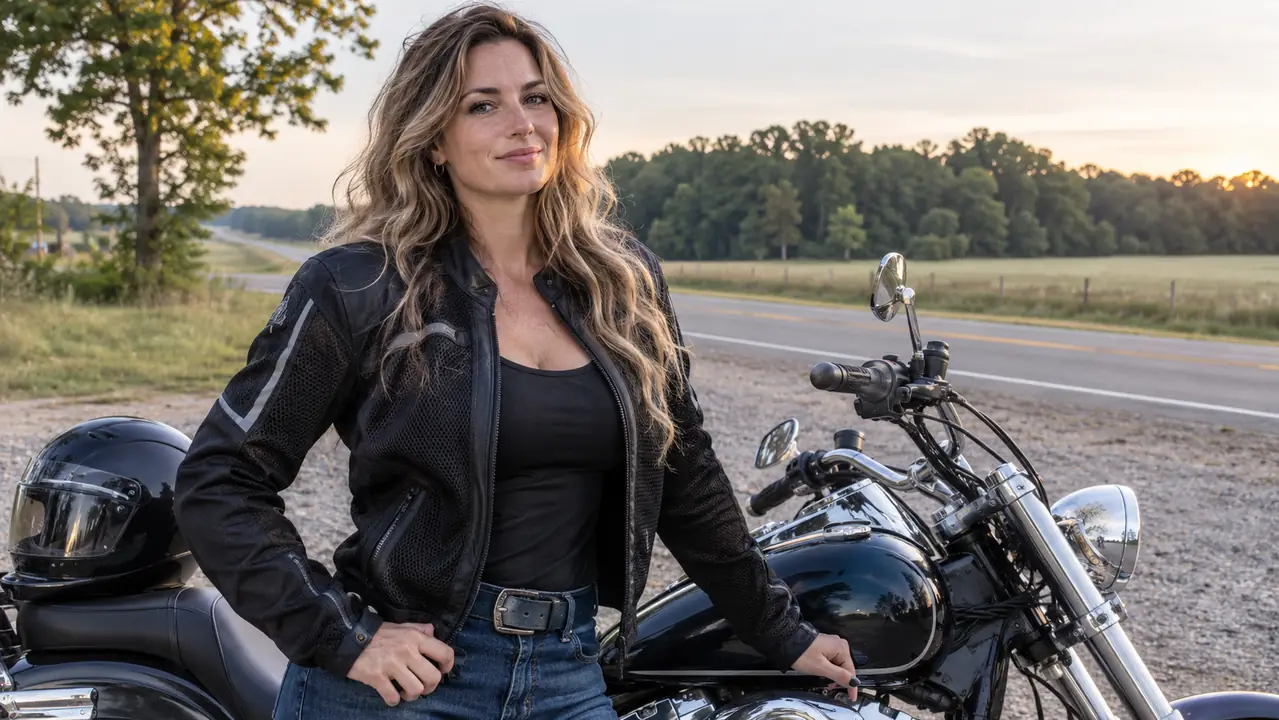
Short answer: for an Oklahoma summer, the BYKR mesh jacket is the one you will still be wearing at the third stoplight. For a 45 degree morning that turns into two hours of rain on the turnpike, a textile touring jacket is the better tool. Those are different jobs, and the mistake is buying one jacket and expecting it to do both.
I have ridden both kinds of jacket on the same 150 mile loop west of Tulsa, in the same month, on the same bike. This is not a shootout where one gets crushed. It is a list of the rows I gave away and the rows I did not, so you can buy for the riding you actually do instead of the riding you daydream about in February. There is a real answer at the end, and it depends on what your weekends look like.
| BYKR Mesh Jacket | Textile Touring Jacket | |
|---|---|---|
| Airflow at 95 degrees | Mesh shell moves air at walking pace, not only at highway speed | Solid shell. Vents help at speed, nothing helps at a stoplight |
| Sustained rain | Water resistant per the listing. Beads a passing shower, not a storm | Built for it. A bonded membrane keeps you dry for the length of the ride |
| Cold mornings | Rated for cold weather, and it works if you layer under it. It is not insulation | Shell plus liner, warm at 45 without three layers underneath |
| Bulk when you stop | One shell. Folds into a saddlebag about the size of a hoodie | Shell plus liner, and both take up room when you peel them off at lunch |
| Pockets | 4 pockets in the listing. Enough for phone, wallet and registration | Touring shells usually run more, with cargo and liner pockets |
| Fit | Regular fit, long sleeve, band collar, cut to sit over a t-shirt | Cut for layering, so it feels roomy through the middle in July |
| Published protection detail | Called protective, but the listing never breaks down armor type or rating | Touring jackets usually publish the armor rating and where it sits |
How I Compared Them
I am 51. Weekdays I am a maintenance supervisor in Tulsa, and I have been riding on weekends for about twenty years. My bike is a mid-size cruiser I have owned for six years, and it is the only motorcycle in the garage. Most Saturdays I do 100 to 250 miles on two-lane roads: Route 66 where it still runs, the lake roads around Grand Lake and Lake Tenkiller, and any county road that looks interesting.
Both jackets got the same treatment, the same loop, the same fuel stops, the same 95 degree afternoon and the same 52 degree morning start. I am not going to tell you that any jacket makes a crash survivable. Nobody honest will. What a jacket does is decide whether you are still comfortable enough to keep it on at mile 120, and on a hot day comfort is most of safety.
I ran that loop on two consecutive Saturdays in June, which around here means the same weather twice by luck rather than planning. The first Saturday the truck thermometer read 78 on the way out of Tulsa at seven in the morning and 96 by one in the afternoon. The second Saturday started at 61 and never got past 89, because a front came through Friday night and left the air cleaner than it has any right to be in June. Same 148 miles, same fuel stop in Kellyville, same burger at the turn. The only thing I changed was the jacket.
I kept notes on the back of a fuel receipt, which is not a scientific method, but it is honest about what I actually noticed. Was I sweating at a stop. Did the collar move around at speed. Was I still zipped at the halfway point or had I given up and let the front hang open. Three summers ago I tried to make one textile shell cover the whole season and quit on it in early July, and that is really where this comparison started.
I slid a bike on gravel years ago at low speed and walked away with scraped gear and a sore wrist. That is the reason I stopped riding in a t-shirt, and the reason I care more about whether gear gets worn than about how it reads on a spec sheet.
The textile jacket in this comparison is not one specific product. It is the three-layer touring shell most riders end up with eventually, the type with a bonded waterproof membrane, a zip-out liner and published armor. I am comparing the two categories as much as two jackets, because that is the actual choice sitting in front of you.
Where the BYKR Mesh Jacket Wins
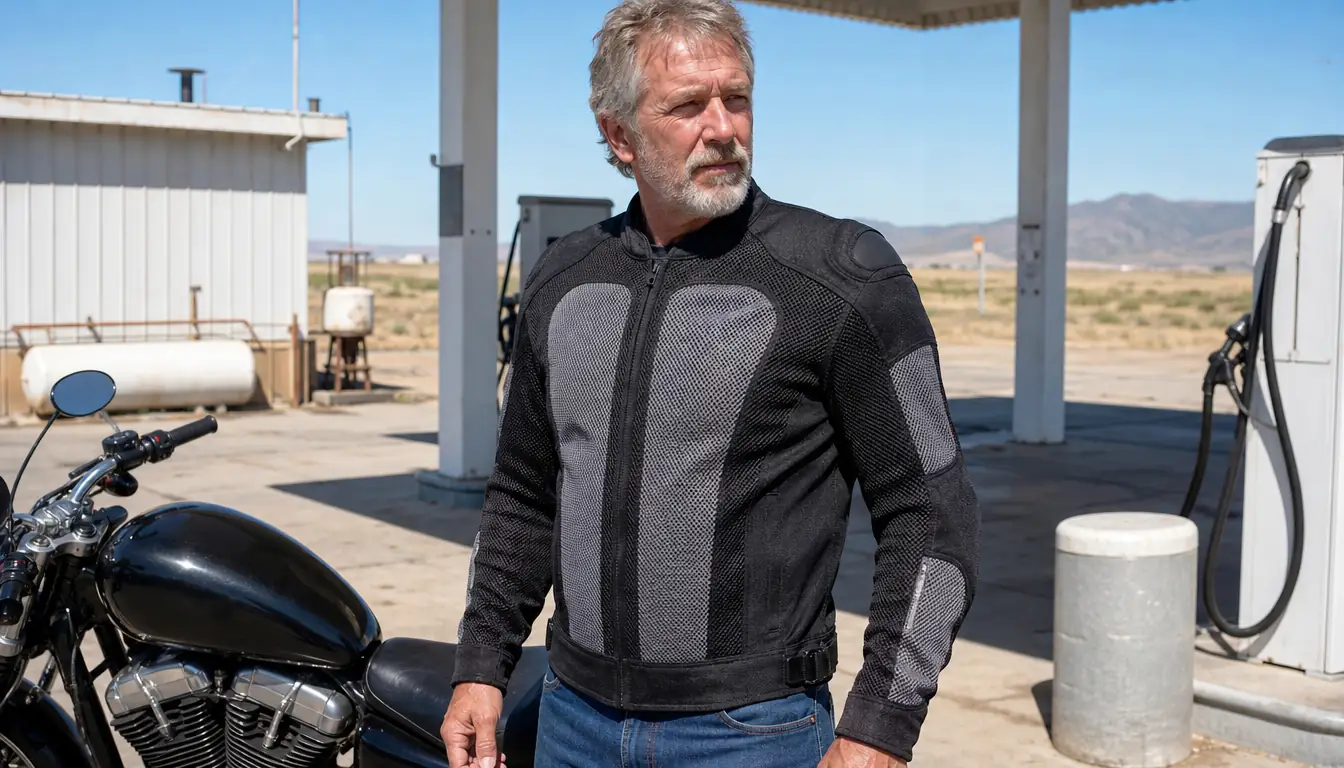
The BYKR jacket wins the heat question, and in Oklahoma that is not a small row to win. Mesh is the entire point of it. Air moves through the shell at walking pace, not only at highway speed, which matters because a lot of a summer ride is spent at 25 miles an hour behind a tractor or sitting at a light with the sun on your back and the engine heat coming up.
Here is a number that stuck with me. On the 96 degree Saturday I counted eleven minutes of stop time across the loop, split between the lights in Sand Springs and two fuel stops where I stood around with a bottle of water. Eleven minutes does not sound like much until you are sitting in it in a solid shell with heat coming off the engine past your knees. In the mesh jacket those eleven minutes were merely unpleasant. In the touring shell on a similar afternoon two summers back they were the reason I unzipped, took the jacket off and rode the last forty miles in a t-shirt, which is the exact thing I am trying to stop doing.
The BYKR is not a cooling device. It is just a jacket that lets the air you are already moving through do its job, and that turns out to be most of the answer on a two-lane road in July.
The second row it wins is the decision to put it on. A jacket that is too hot gets left on the wall rack in the garage, and a jacket on the rack protects nobody. I have done July rides where the touring shell stayed home and the mesh went on, and I was better off for it. BYKR calls the jacket breathable and it is, in the way a mesh jersey is breathable. That is the only fair comparison for mesh.
It wins on bulk too. One shell, nothing to zip in or out at a fuel stop, no liner to hunt for in October. It folds into a saddlebag about the size of a hoodie and it is there if the afternoon turns. That sounds minor until you have stood in a gas station lot in 100 degrees wrestling a liner into a jacket you already regretted wearing.
Mesh wins the only question that matters in July: is the jacket still on you at mile 100, or is it strapped to the back of the bike?
Where the Textile Touring Jacket Wins
The touring jacket wins rain and it is not close. BYKR lists the shell as water resistant, with waterproof and windproof protection in the weather field, and that is honest labeling for what it is. Light rain beads up and blows off. A storm that keeps up for half an hour soaks through the shoulders, and a proper membrane does not.
The rain row is also where I am least tempted to be generous to mesh, so here is the specific day. I got caught coming home from Grand Lake in a storm that came up out of the southwest faster than the forecast said it would, and I was forty minutes from the garage when it hit. The jacket beaded water for the first ten minutes. Then the shoulders and the top of the chest started soaking through, and by the time I rolled into the driveway I was damp underneath in that way that takes an hour to shake off. A bonded membrane would have shrugged that storm off without a thought. That is not a defect in the BYKR. It is what water resistant means on any shell, and the label says exactly that.
I have ridden that same stretch of road in a proper touring shell in worse rain and stayed bone dry, and I paid for that in July the way every touring rider pays for it.
It wins cold mornings. The listing puts the BYKR jacket in mild, warm and cold weather, and with a windproof layer under it I have been comfortable down to about 55 degrees. Below that, mesh is a wind tunnel with a zipper attached. April in Oklahoma will hand you 52 at eight in the morning and 84 by two, and the touring shell handles both ends of that day without you changing clothes twice.
The last row it wins is the boring one, the paperwork. A touring jacket from a serious maker usually tells you what the armor is, what rating it carries and where it sits. The BYKR listing calls the jacket protective and stops there. That is not a knock on how it is built, it is a gap in what is published, and if armor rating matters to you, ask the seller before you order instead of assuming.
The Jacket You'll Still Have On at the Third Stoplight
BYKR mesh riding jacket, 4.6 stars from 764 buyers. Water resistant shell, 4 pockets, zip front, regular fit. Check the current price and the size chart before you pick a size.
Amazon Check Today's Price on Amazon →
What the BYKR Spec Sheet Actually Says
I read listings closely, because a lot of riding gear copy is written by people who have never sat on a motorcycle. Here is what the BYKR listing actually claims: mesh construction, breathable, a zipper front, four pockets, a band collar, long sleeves, a regular fit, water resistance, waterproof and windproof weather protection, and suitability for mild, warm and cold weather. That is a short list, and short lists are easier to check against the thing in your hands.
One field made me laugh. The material field says leather. On a jacket sold as mesh that cannot be right, and it is a fine reminder that marketplace spec fields are typed by somebody in a hurry. Trust the title, the photos and the return window. The 4.6 star average across 764 reviews is the more useful number, and the complaints buried in that pile are worth ten minutes of reading before you order.
Living With It on a Weekend Ride
Four pockets is enough for the way I ride: phone, wallet, registration and earplugs. The front closure is a full length zipper, and the band collar sits below the chin without sawing at your throat at speed, which is more than I can say for two jackets I have owned. Regular fit means it goes over a t-shirt without ballooning, and it does not flap like a sail at highway speed.
Fit deserves its own paragraph because it decides whether you keep the jacket. I am 5 foot 10 and about 195 pounds, and a large over a t-shirt leaves room at the waist without pulling across the shoulders when I reach for the bars. The sleeves stay down over my wrists at full reach, which is the fit problem I have had with cheaper jackets that ride up the moment you stretch. If you are between sizes, measure your chest and work off the chart instead of guessing, because a jacket that is too tight is a jacket that lives on the rack.
That regular cut is also why it does not balloon at 65 miles an hour the way a loose shell does, and why I made it through the last thirty miles of the loop without stopping to re-zip anything.
Water resistance is the one place I would set expectations low, and I said the same thing earlier with a specific storm attached to it. Light rain on the way back from Grand Lake, water beaded and I stayed dry. A spring storm that kept up for forty minutes, I got damp through the shoulders. If you ride in rain on purpose, buy a jacket built for rain.
What I Liked
- Air moves through the shell at a stoplight, not just at speed
- One shell, nothing to zip in or out at a fuel stop
- 4 pockets and a full length zip front
- Band collar that stays off your throat
- Water resistant enough for a passing shower
- 764 reviews averaging 4.6 stars
Where It Falls Short
- Sustained rain gets through the shoulders
- No published armor rating on the listing, so ask before you buy
- Below about 55 degrees you need a layer under it
- The material field says leather, which cannot be right on a mesh jacket
Who Should Buy Which
Buy the BYKR mesh jacket if your season is May through September, if your rides are 100 to 250 miles of two-lane with a sweet tea stop in the middle, and if the jacket you owned before this one spent most of last summer hanging on the rack. It is also a reasonable first jacket for someone still working out whether they are a rider, because it asks less commitment than a three-layer touring shell.
Buy the textile touring jacket if you leave before sunrise, if you ride through weather instead of around it, if you want the armor rating published on paper, or if your season runs from March to November. It is heavier, hotter and bulkier, and on a 95 degree afternoon you will be jealous of the mesh rider at the light. That is the trade and it is a fair one.
If you can only own one, be honest about which riding you do most. Most weekend riders around here do the hot version far more often than the wet version, then buy for the wet version anyway and wonder why July is miserable. Nothing says you cannot own both and leave the touring shell on the rack until October. I know which one hangs on my rack in August.
Buy for the Riding You Do, Not the Riding You Daydream About
BYKR mesh riding jacket, regular fit, zip front, 4 pockets, water resistant shell, 4.6 stars from 764 buyers. Check today's price and confirm your size on the chart.
Amazon Check Today's Price on Amazon →