
Short answer: for riding, the Harley-Davidson Brake Buckle boots do a job the work boots in my closet were never built for. They sit still on the peg. I ran two Saturday loops of roughly 240 miles each, one in the Brake Buckles and one in my regular 6 inch lace-up work boots, on Route 66 west of Tulsa and the two-lane roads around Grand Lake. The gap showed up before the first fuel stop. It was not dramatic. It was small and constant, and by the end of the day it had added up to something I could feel in my calves.
I am Gary Lockridge, 51, and I have been riding weekends for about twenty years on the same mid-size cruiser. Weekdays I am a maintenance supervisor, which means forty hours a week in a lace-up work boot. I know that boot the way you know a kitchen chair. That made the comparison easy to set up and harder to settle than I expected, because a work boot is genuinely good at what it does. It is just not good at everything.
| Brake Buckle Boots | Regular 6 Inch Work Boots | |
|---|---|---|
| Ankle coverage | Ankle-high shaft with an 8 inch circumference, sits just above the ankle bone and under the pant leg | Most run 6 inches or taller and cover more of the shin |
| Closure | Pull-on, so there is no lace to snag on a peg, a footboard or a hot pipe | Laces let you tune the fit across the instep in a way no slip-on can |
| Sole and heel | Rubber sole on a low heel, so the foot sits flat on the peg instead of hanging off the edge | Deeper lugged outsole and a taller heel, built for gravel, mud and concrete |
| Heat | Unlined leather, listed for summer wear | Liners and membranes hold heat on a 95 degree Oklahoma afternoon |
| Water | Not water resistant. Leather takes on water and stays damp overnight | Many pairs carry a waterproof membrane |
| Weight | Four pounds on the listing | Add a safety toe and a lugged outsole and that number climbs |
| Shift lever feel | Low heel and a rubber sole, so you feel the lever through the boot | A thicker sole mutes the lever and you learn to shift harder |
| A long day off the bike | Fine for a diner, a gas station and a walk to the overlook | Built for ten hours on concrete |
| Toe | Round leather toe, no safety toe and no safety rating | Safety toe versions are common |
| Best for | Weekend day rides and wearing off the bike afterward | Job sites and full days on your feet |
How I Compared Them
Same bike, same roads, similar weather, and a fuel stop every sixty miles or so where I got off and actually paid attention. At each stop I checked four things: how hot my feet were, whether the heel had slipped, whether the leather had taken any water, and whether I had to think about the shift lever. That last one is the tell. A boot that makes you think about shifting is a boot you will resent by mile 150 in stop and go traffic on a hot afternoon.
Fairness note. My work boots have years of break-in on them, so I put a few hundred short town miles on the Brake Buckles first to even that out. Spring in Oklahoma also handed me both conditions I needed: a hot, windy Saturday and an afternoon that turned dark and wet on the way home. One thing I want to say plainly, since this is a gear site and someone will ask. Neither of these is safety equipment in the armored sense. Leather and rubber do not make a crash survivable. They cover your foot against heat, weather and the bike itself, and that is the honest claim I will make for either pair.
Where the Brake Buckle Boots Win
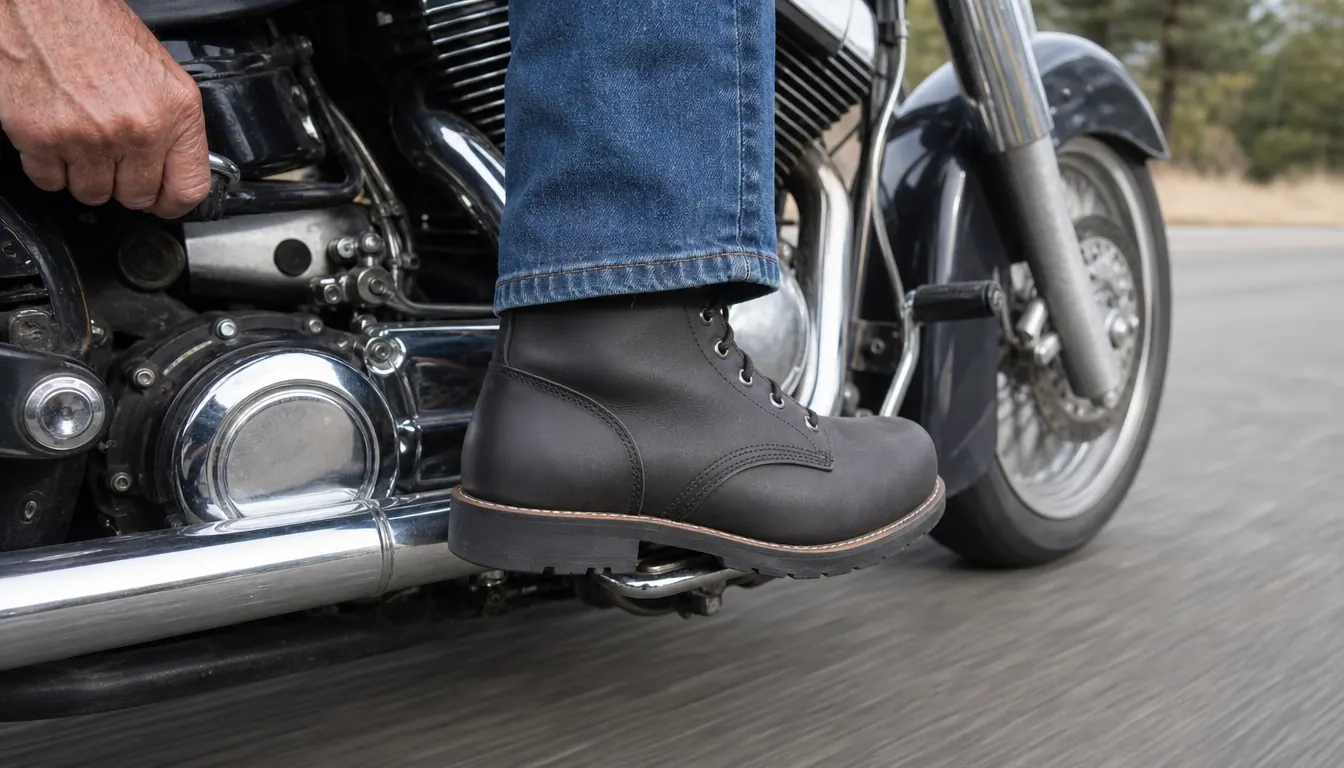
The low heel is the whole thing. On a cruiser your foot rests on a peg, and your heel either sits down on it or hangs off the back edge waiting to catch on something. The Harley-Davidson Brake Buckle has a low heel and a rubber sole, so my foot sat flat and quiet for the length of a tank. The round toe slid under the shift lever without hunting for the gap. On the work boots, the deeper lugged outsole meant I had to lift my toe higher to get a clean shift, and I got it wrong twice at low speed in the first twenty miles. Twice is enough to notice.
The second win is heat. Unlined leather breathes in a way a lined work boot does not, and the listing puts these in the summer category. On a 95 degree afternoon with a hot engine between your legs, that matters more than anything printed on a spec sheet. My work boots left my socks damp by the second hour. The Brake Buckles did not. The pull-on closure also means there is no lace to catch on a peg, a footboard or a hot exhaust pipe, and nothing to fiddle with when you stop for lunch. I was out of them and into a diner booth in about four seconds.
Where Regular Work Boots Win
Water. That is the one that decided it for me, and it is not close. The Brake Buckle is listed as not water resistant, and it means it. I caught a spring storm on the way back from Grand Lake, the kind that drops two inches in twenty minutes, and by the time I got home the leather was soaked through and stayed damp overnight. My work boots have a waterproof membrane and would have shrugged that off. If you commute, or if you ride through Oklahoma spring weather without checking a radar first, this is the tradeoff that matters most.
The other win is everything that happens after you get off the bike. Work boots are built for ten hours on concrete, with a lugged outsole and, in a lot of pairs, a safety toe. The Brake Buckle has a round leather toe and no safety rating at all. I did a walk of maybe a quarter mile around a roadside antique place in each pair, and the work boots were the obvious choice for anything longer than that. I also lost some shift feel through the thicker work boot sole, which surprised me, but I would take that back in exchange for dry feet and a toe cap on a job site.
I rode 240 miles on Route 66 in one Saturday and never once thought about my feet. That is the highest compliment I can pay a motorcycle boot.
What the Spec Sheet Actually Tells You
Stripped down, the Harley-Davidson Brake Buckle is a leather pull-on ankle boot with a rubber sole, a low heel, a round toe and no lining. Ankle-high shaft, 8 inch circumference, four pounds on the listing. It is sold as a casual boot and it is listed for summer. Read that list back and you can predict the whole review: easy to get on, comfortable in heat, poor in standing water, and not much of a walking boot. Everything I found on the road matches that list, which is usually a good sign that a product is being described honestly.
The buckle is listed as an embellishment, so treat it as a detail and not a fit adjustment. Do not buy this expecting to snug the boot down with a strap. The 8 inch circumference around an ankle-high shaft is a fairly snug opening, and it is the number to check if you have a wide foot or you wear heavy socks. There is no membrane, no liner and no safety toe. Nothing on the boot is going to do armor work. It is leather over a rubber sole, done well, and it does not pretend to be more.
The four pound figure is the other one worth a thought, since a heavier boot tires an ankle sooner over a long day. It is a reasonable number for a leather boot with a rubber sole and it is not the reason to skip the boot. Heat and water are the reasons to think twice, and I would rather you hear that from me than find it out on I-44 with forty miles left to go.

Fit and the Pull-On Tradeoff
A pull-on boot has one weakness. You cannot adjust it. Laces let you loosen the instep and lock the ankle. Pull-on gives you the fit you bought and nothing more, so the try-on matters more here than it does with a lace-up. Wear the socks you actually ride in, walk around the room, and take note of heel slip. A little is normal in new leather. A lot means the boot is too long, and no amount of break-in will fix that.
Break-in was short. Unlined leather with no liner and no membrane tends to move quickly, and mine were comfortable by the third short ride, with a bit of stiffness left across the top of the foot. That stiffness faded out. If a pull-on is tight across the instep on day one, assume it stays a little tight, because there is no lace to give it slack later.
One more thing that sounds fussy and is not. Sock choice. The unlined leather plus the friction of a pull-on shaft means a thin cotton sock rides down and bunches at the heel by mile 60. A sock with some weight to it, and a seam that is not sitting on the ankle bone, fixed that for me completely. It also helps with heat, oddly enough, because a dry sock insulates better than a damp one.
What I Liked
- Low heel sits flat on the peg instead of hanging off the edge
- Round toe slides under the shift lever without hunting for the gap
- Unlined leather stays noticeably cooler in summer heat
- Pull-on closure leaves nothing to snag on pegs, boards or pipes
- Ankle-high shaft tucks under jeans and covers the ankle bone
- Looks fine off the bike at a diner or a gas station
Where It Falls Short
- Not water resistant, and wet leather stays damp overnight
- Pull-on fit cannot be adjusted after you buy it
- No safety toe and no safety rating
- Rubber sole and leather are not armor, so do not expect crash protection
- Not a boot for a long walk once you stop
The Gravel Story, Since It Always Comes Up
Years ago I went down at low speed on a gravel shoulder. I walked away with scraped gear and a sore wrist, and it is the reason I pay attention to gear instead of treating it as costume. I mention it because it shapes how I judge a boot. What I want in that kind of moment is coverage over the ankle and something that stays on my foot while the bike and I are separating.
An ankle-high pull-on with an 8 inch circumference does cover the ankle, and it stays on because there is no lace to come undone and no buckle to work loose. It is still not armor. Leather scuffs and rubber wears through. But a boot that covers the bone and stays on your foot is worth a lot more than a slip-on sneaker with a fashionable sole, and I have watched people ride in those on Route 66 more times than I can count.
The peg is where these boots earn their keep
Leather, rubber sole, low heel, round toe, pull-on. If your riding is weekend day rides in warm weather, this is the shape you want on your foot.
Amazon Check Today's Price on Amazon →Who Should Buy Which
If your riding is weekend day rides in warm weather, 100 to 250 miles on two-lane roads, and you want one boot that works on the bike and in a diner afterward, the Harley-Davidson Brake Buckle is the shape you want. Low heel, round toe, unlined leather, pull-on, nothing to snag on the bike. It matches the way most of us actually ride, which is to a lake and back with a stop for pie.
If you commute, if you ride through a wet spring, if you want a safety toe, or if your stops include long walks, stay with a real work boot or buy a proper touring boot with a membrane. There is no version of this comparison where leather with no water resistance beats a membrane in an Oklahoma downpour. And if you already own a broken-in pair of work boots and your rides are under an hour, you are not missing nearly as much as a gear site wants you to think.
What I do now is keep both. The work boots go to the job site Monday through Friday, since that is what they were made for. The Brake Buckles hang on the wall rack in the garage next to the helmet and come out on Saturday. That is not a compromise. It is picking the right tool twice, and it is the cheapest gear decision I have made in years.
One boot for the ride and the diner after it
Four pounds, ankle-high leather, no laces to think about. Own the work boots for Monday and this pair for Saturday.
Amazon Check Today's Price on Amazon →