
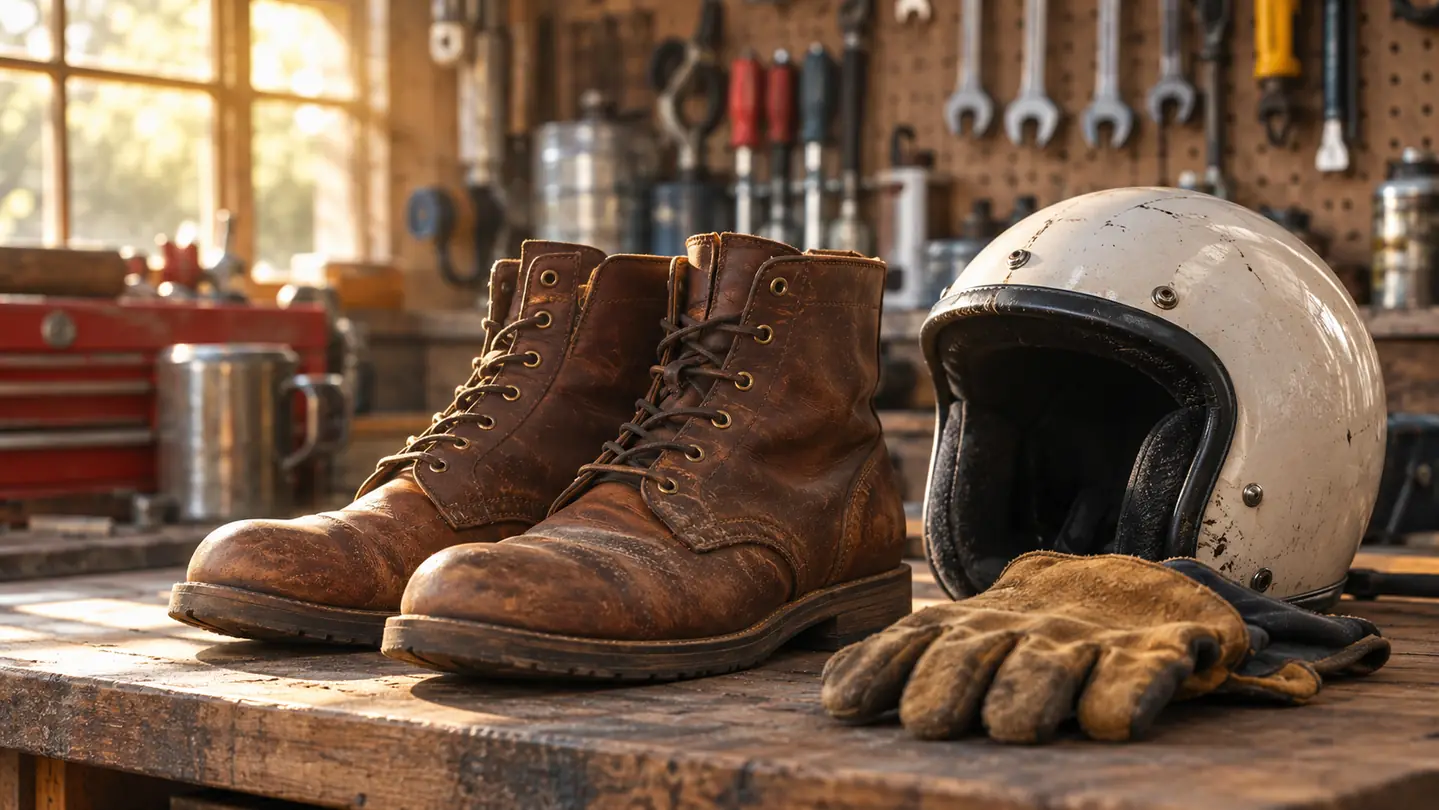
The first thing I noticed about the Harley-Davidson Brake Buckle boots was not the buckle. It was the weight. Four pounds of leather and rubber set down on my workbench, and I stood there thinking about what that feels like at hour six of a two hundred mile day. I have been riding weekends for about twenty years out of Tulsa, mostly two lane roads and the lake loops around Grand Lake and Tenkiller, and I have owned more pairs of boots than I care to explain to my wife Donna. Most were fine. A couple were a waste of a good Saturday. So when I tell you these are worth your attention, and also worth arguing with, that is where I am coming from.
This is the honest version, not the eight hundred word version where everything is wonderful and then a footnote says results vary. There are things about these Harley-Davidson boots I would change tomorrow if somebody handed me a pen, and the biggest one announces itself the first time you get caught in an Oklahoma spring storm. But I still reach for them more than anything else on the rack in the garage, and I want to explain exactly why, and exactly when I would tell you to buy a different boot.
The Quick Verdict
A heavy, well built pull-on leather boot that gets genuinely comfortable around week two and stops making sense the moment the road turns wet.
Amazon Check Today's Price →The Pair That Lives By My Garage Door
Short version: slow break-in, honest leather, years of wear, and zero water resistance. If that trade works for how you ride, today's price on Amazon is the place to start.
Amazon Check Today's Price on Amazon →What Nobody Tells You About Breaking Them In
There are no laces on these boots. The closure is pull-on, plain and simple, and that single fact changes your entire first week of ownership. A laced boot lets you cheat. You can leave the top eyelets loose, you can retie at a rest stop, you can tell yourself the fit is improving while the leather catches up. None of that is available here. Whatever the boot does to your foot in week one is what it does, and your job is to ride it out.
For me that meant five days of short wear before I ever put a leg over the bike in them. I wore them around the garage while I checked tire pressure and topped off fluids. I wore them to the hardware store and to church, which Donna found funny enough to mention twice. By day three the shaft had started to fold where my ankle actually bends instead of where the pattern assumed it would, and by the end of week two they stopped announcing themselves when I walked. That is the honest timeline. Two weeks, not two days, and anybody telling you otherwise has not worn a pull-on leather boot.
Before I settled into that routine I tried to rush it, and the mistake is worth passing along. On day two I dug out a tin of conditioner I keep for a leather jacket and worked it into both boots, figuring soft leather would fold faster. What it actually did was darken the left boot unevenly and leave the right one slick enough that my sock slid down inside it on the walk back from the mailbox. I wiped off what would come off with a rag and left them alone after that. The break-in that worked was the boring one: wear them, walk in them, let leather do what leather does. If somebody on a forum tells you to soak them or warm them with a hair dryer before the first ride, I would skip it. Stiff leather that gets forced tends to crease in the wrong place, and a crease in the wrong place is there for the life of the boot.
One thing worth saying out loud before you order: if you have a wide foot or a high instep, a pull-on boot listed at eight inches of shaft circumference is not a forgiving fit. There is no lace to give you slack. My advice is to try them somewhere with a return policy you actually trust, or go a half size up and plan on a heavier sock for the first month of riding.
The Weight Is the First Thing You Notice
Four pounds. That is the listed weight, and my postal scale at home agreed with it closely enough. On paper that number means nothing. On your foot at a stoplight, it means the boot wants to keep going when your leg stops. It also means the sole and the leather are not thin, which is the reason I am still wearing them. Light boots feel great for a season and then the sole cups and the heel rolls inward and you are shopping again.
I weighed them myself on the kitchen scale the night they arrived, mostly because Donna did not believe the number printed on the listing. Left boot, right at two pounds. Right boot, a hair under. Two pounds a side is roughly double the lined work boots I keep by the back door, and it is not the kind of difference you notice standing still. Where it shows up is town. There is a stretch of stop and go on the way out to the highway where you are putting a foot down every hundred yards, and by the tenth stop the boot is doing more work than your leg expects. It also shows up loading the bike in the driveway, where a lighter boot lets you pivot and these make you pick your foot up properly. What that weight buys you is a sole that does not flex like a sneaker and a boot that stays exactly where you set it on the peg. On a cruiser, I will take that trade every time.
The tradeoff is real though. If you are coming off a sneaker or a lightweight hiking shoe, the first three rides will feel like you are wearing anchors. It fades. The leather softens, your leg gets used to it, and by the fourth weekend you stop thinking about it at all. But I would be lying if I said day one felt natural. It did not.
The Fit Details That Actually Matter
The shaft is ankle high, and it sits right at the bone without pressing on it. The toe is round. That sounds like a spec nobody needs until you have spent a full day in a pointed boot with your toes stacked on top of each other. Round toe means you can actually wiggle your toes at a long light, which matters more at mile one hundred fifty than at mile five.
The heel is low, and that is the detail I would put on the box if I were in charge. A low heel lets your foot sit flat on the peg instead of rocking forward over the ball of your foot. On a hundred mile day that difference shows up in your calves and your lower back. The upper is leather, the sole is rubber, and the inside is unlined.
Unlined is a genuine tradeoff, not a marketing word. It breathes a little better in July heat, and it also means there is no soft layer between your sock and the inside of the boot, so you will feel the seams for the first week or so. Mine stopped being noticeable right around the same time the shaft softened. If you are sensitive to seams, wear a thicker sock during break-in.
By the end of week two the leather had folded where my ankle actually bends, and the boots stopped announcing themselves when I walked.
Where These Boots Fall Short
The listing says it plainly and I will say it plainly too. These boots are not water resistant. Not water resistant at all. I got caught on Route 66 in April by the kind of storm that shows up out of a clear sky and turns a dry two lane road into a creek in ten minutes. Twenty minutes of that and my socks were done, water straight through the leather and straight to my foot. If you ride through weather instead of around it, this is the wrong boot for you, and that is the whole answer.
The part that stung was that I had checked the forecast that morning and it said thirty percent. Thirty percent is a gamble I take most weeks in April, and most weeks it costs me nothing. This time it cost me a pair of socks and about forty minutes of real discomfort. I pulled into a station in Stroud, wrung the socks out in the restroom, and put them back on wet because I still had sixty miles to get home. The boots themselves came through it better than I expected. I stuffed them with newspaper and left them in the garage for two days and they dried with no cracking and no smell. So credit where it is due. But the lesson stuck, and now I keep a cheap set of rain covers in the saddlebag from March through June and I do not leave the house in these when the radar looks green.
Second, the buckle. The listing files it under embellishment rather than closure, and that matches what I found: it does not take up slack, it does not tighten anything, and it is not the thing holding the boot on your foot. If your fit needs adjusting, you need a different boot, not a tighter buckle. Pretending otherwise only leads to a sore ankle at mile forty.
Third, there is nothing here to fine tune. Pull-on means pull-on. No laces, no straps that do anything, no half sizes of adjustment on a hot day when your feet swell. You get the fit you get.
And the biggest honest point of this whole review. These are casual riding boots, not protective equipment. There is a leather upper and a rubber sole and that is the sum of what you are buying. No boot makes a crash survivable, and anybody who tells you otherwise is selling you something. I have a low speed slide on gravel in my past, and what it taught me is that gear reduces damage, it does not erase it. Buy these because they are comfortable, because they hold up, and because they feel planted when you put a foot down. Not because you believe they will save your ankle.
What I Liked
- Pull-on design with nothing to tie and nothing to catch on a peg
- Leather upper and rubber sole hold up to honest mileage
- Settles into a proper ankle fold in about two weeks
- Low heel sits flat on the footpeg on long days
Where It Falls Short
- Explicitly not water resistant
- No laces means no way to adjust the fit
- Four pounds per pair is real weight on your feet
- Unlined inside, so the seams are felt for the first week
How They Hold Up After a Season
I have run these through a spring and most of a summer now, a bit over eighteen hundred miles of Oklahoma back roads plus a lot of standing around in parking lots and driveways. The sole has worn evenly. The leather has creased across the toe and softened everywhere it bends, which is what leather is supposed to do. The stitching has not started anywhere that I can find, and I have looked.
I keep a small notebook in the garage where I write down mileage and anything that needs attention, mostly because I forget things. The boots went on for the first time in late March. The last entry before I sat down to write this puts them at eighteen hundred and forty miles, and the notes in between are short and mostly uninteresting, which is the report you want. They got wet twice. They got scuffed once against a curb in a parking lot on the east side of Tulsa, a straight black mark across the outside of the left toe. It came out with a brush and a little conditioner over two sittings. The road dust from our gravel shoulders does not come out and never will, and I have made peace with that.
What surprised me is how little the inside has broken down. Pull-on boots often go shapeless at the heel once they pack out, and that is where a cheap pair starts to fail. These have held their shape back there. Nothing on them has separated, no welt stitching has opened, and the leather has not cracked anywhere across the flex point at the toe, which in my experience is where a lesser boot goes first.
The place I expect wear first is the sole under the ball of the foot, because that is where any rubber sole goes on a bike when you are putting a foot down at every stop sign in town. So far it is holding fine. What I can tell you honestly is how these look at one season. I cannot tell you how they look at five, because I am not there yet.
What They Are Not
It is worth being clear about the category, because the Harley-Davidson name and the styling can mislead a new rider. These are not rain boots. They are not insulated. The listing puts them in the summer category, and unlined leather in cold weather is exactly as warm as it sounds. They are not a work boot with a reinforced toe, and they are not a touring boot built for eight hundred mile days. They are a casual leather ankle boot that happens to work well on a cruiser for a weekend ride, and they are good at that specific job. The name on the side does not change what the boot is, and buying it for a job it was not built for is how you end up unhappy with a perfectly decent pair of boots.
Who This Is For
This is for the rider who does day rides rather than tours. Weekend runs of a hundred to two hundred and fifty miles, two lane highways, a stop for lunch, home before dark. It is for somebody who wants one boot that works on the bike and does not look strange walking into a diner afterward. The Harley-Davidson styling is right there on the outside, so if that look appeals to you, it appeals to you, and there is no point pretending style had nothing to do with your decision.
It is also for the rider willing to spend two weeks getting them comfortable and who does not need day one to feel perfect. That is the entire bargain with a pull-on leather boot. You pay upfront in patience, and then you get years out of them.
Who Should Skip It
If you commute year round, skip these. Not water resistant is not a small footnote in a climate with regular rain. Same if you ride in the cold, because unlined leather does not hold heat. Same if you need a boot you can tighten or loosen through the day, because there is nothing on these to tighten.
And if you want a boot that feels broken in the moment it comes out of the box, this is not that boot. Two weeks is two weeks. Some folks will put them on, ride fifty miles, feel their heel lift slightly on the upstroke, and decide they hate them. That heel movement is normal and it does stop once the leather takes its set. But if you are not willing to go through it, buy something with laces and save yourself the aggravation.
Two Weeks of Patience, Then Years of Wear
Leather upper, rubber sole, low heel flat on the peg, and a break-in period you have to earn. Just know going in that they are not water resistant. Today's price is on the product page.
Amazon Check Today's Price on Amazon →